

Community
Land Acknowledgments
A Land Acknowledgment is an opportunity for you to recognize whose lands you are on.
Who provides them?
The purpose of a land acknowledgment is to acknowledge the Tribe(s) whose homelands you occupy. External individuals and entities provide land acknowledgments. The FTBMI does not provide land acknowledgments.
What does the Tribe do?
The FTBMI accepts the land acknowledgment and provides a welcome to FTBMI homelands.
Key messages:
The Fernandeño Tataviam Band of Mission Indians is grateful for the greater Los Angeles community reaching out in good faith to acknowledge the Tribe through “Land Acknowledgment Statements.” Since the Tribe is inundated with requests, we ask that visitors review the information on this page before contacting the Tribe.
Additionally, the content on this page represents the views of the FTBMI. Please contact other Tribal Nations if you would like information on their unique protocols and perspectives. As institutions, organizations, and communities seek the development of land acknowledgments, here is some helpful information to consider.
ESTABLISH A MEANINGFUL RELATIONSHIP.
RECOGNIZE ORIGINAL PLACENAMES.
NAME THE TRIBE IN PRESENT TENSE.
UPLIFT OUR HISTORY & EXISTENCE.
Original placenames:
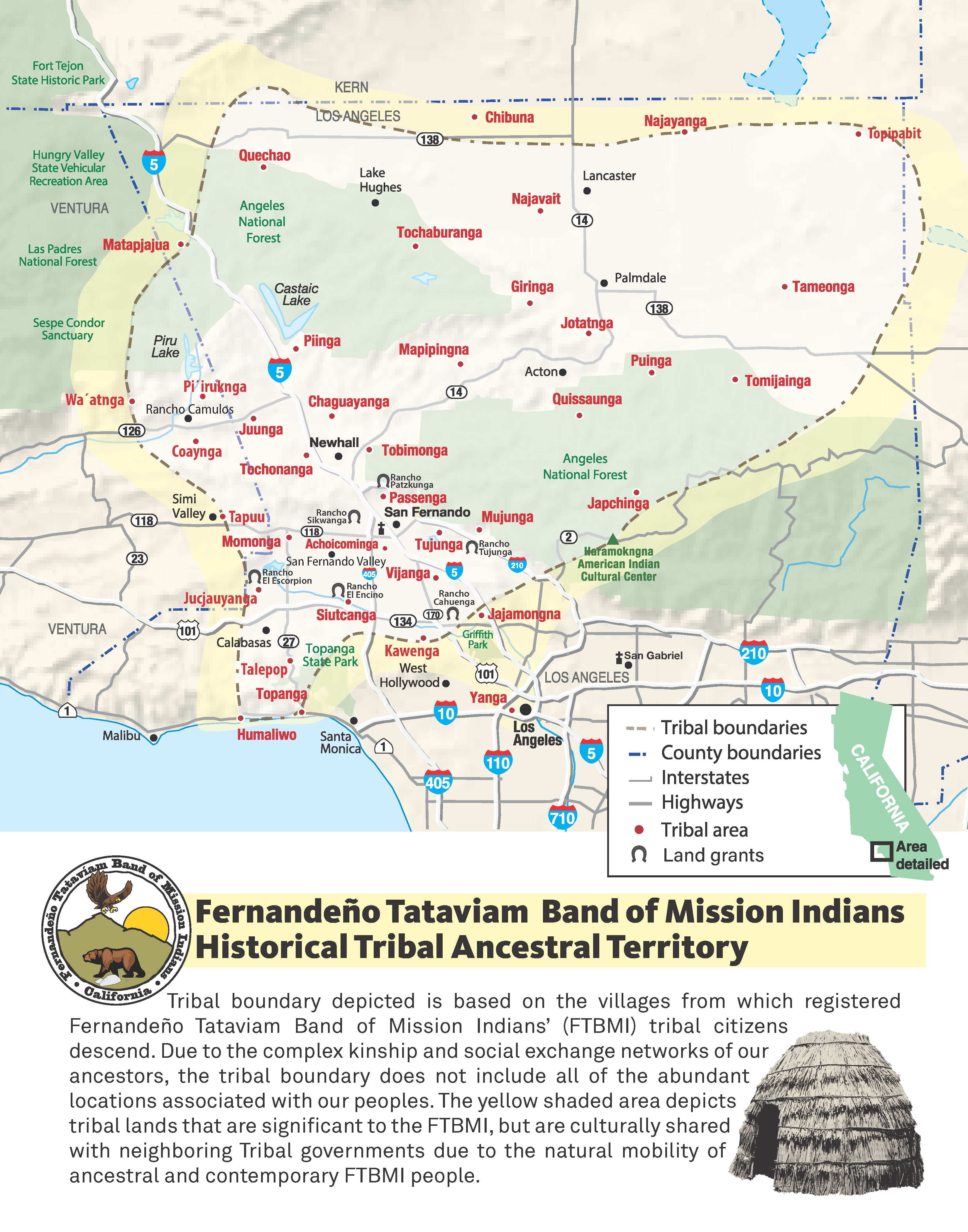
Not all of our villages are mapped due to the potential threat of looting. Find the nearest village located on the map.
Sample Language
The proper way to write a land acknowledgment on Fernandeño Tataviam homelands is to name the actual village your institution occupies, followed by the tribe’s name, where village descendants are enrolled as citizens. As a village–based people it is critical to continue to honor our villages and land, and to recognize our ancestors, elders, and future generations to come.
[YOUR ENTITY] recognizes and acknowledges the first people of this ancestral and unceded territory of [VILLAGE NAME] that is now occupied by our [YOUR ENTTITY]; honors their elders, past and present, and the descendants who are citizens of the Fernandeño Tataviam Band of Mission Indians. We recognize that the Tribe is still here and we are committed to lifting up their stories, culture, and community.”
Centering Reciprocity
Land Acknowledgments may seem performative if they lack a meaningful relationship with the Tribe, grounded in reciprocity and respect. Here are some of the ways in which our allies support and relationship-build with us:
- Inclusion of FTBMI community in policy initiatives and campaigns
- Inclusion of FTBMI and Native Americans in data sets
- Inclusion of FTBMI history in K-12 curriculum
